


Potassium Bromide (KBr) Windows, Drilled Discs and FTIR Beamsplitters: 0.25 – 26 µm
Alkor Technologies manufactures custom potassium bromide (KBr) optical components — windows, drilled cuvette discs, wedges and FTIR beamsplitter/compensator pairs on our own production site in Saint Petersburg, Russia. KBr provides the broadest transmission range of all common alkali halide optical materials: 0.25 to 26 µm, covering the complete mid-IR fingerprint region down to 400 cm⁻¹. Maximum blank size 100 mm diameter × 20 mm thickness. All KBr optics shipped in sealed packaging with silica gel desiccant as standard. Optional moisture-protective polymer coating (Parylene analog) available for extended service life. Custom quote within 24 hours.
Please contact Sales Team for more information.
Please visit our KBr windows catalog.


Standard Sizes: Catalog of KBr Windows
We manufacture KBr windows in standard sizes compatible with all major FTIR cuvette holders. Custom dimensions to drawing. All sizes available plain (undrilled) and drilled (with filling hole).
Round KBr windows | |
|---|---|
| KBr 13x2 | not drilled |
| 15 x 2 мм | not drilled |
| 19 x 2 мм | not drilled |
| 20 x 2 мм | not drilled |
| 22 x 2 мм | not drilled |
| 22 x 4 mm | not drilled |
| 25 x 2 мм | not drilled |
| 25 x 4 мм | not drilled |
| KBr 32x3 мм | drilled/ not drilled |
| 38 x 3 мм | not drilled |
| 38 x 6 мм | not drilled |
| 40 x 4 мм | not drilled |
| 49 x 6 мм | not drilled |
| 50 x 3 мм | not drilled |
| Also available in the same sizes in NaCl, KCl, ZnSe, BaF₂, CaF₂, Ge | |
Rectangle KBr windows
Rectangle KBr windows | |
|---|---|
| 29.5 x 14.5 x 2 mm | drilled/ not drilled |
| 29.5 x 14.5 x 4 mm | drilled/ not drilled |
| 35.8 x 19.8 x 4 mm | drilled/ not drilled |
| 38.5 x 19.5 x 4 mm | drilled/ not drilled |
| 41 x 23 x 3 mm | drilled/ not drilled |
| 41 x 23 x 4 mm | drilled/ not drilled |
| 45 x 20 x 6 mm | drilled/ not drilled |
| 50 x 25 x 6 mm | drilled/ not drilled |
| Also available in the same sizes in NaCl, KCl, ZnSe, BaF₂, CaF₂, Ge | |
Compatible with: Thermo Fisher Scientific (Nicolet), PerkinElmer (Spectrum), Agilent (Cary 600), Shimadzu (IRAffinity, IRTracer), Pike Technologies, Bruker, JASCO and most other FTIR platforms. Also available in the same sizes in NaCl, KCl, ZnSe, BaF₂, CaF₂, Ge — all from one supplier.
Why KBr: The Only Alkali Halide That Covers the Complete Mid-IR
KBr has a slightly more extensive spectral range than Sodium Chloride and has excellent transmission from 250 nm to 26 µm. This one statement captures the essential reason KBr is the default choice for FTIR spectroscopy over its closest rival NaCl.
The mid-IR spectral region (2.5–25 µm / 4000–400 cm⁻¹) contains the characteristic absorption bands of essentially all organic and inorganic compounds — it is the fingerprint region. IR grade KBr enables an extended wavelength range of 4000–400 cm⁻¹ compared to sodium chloride's 4000–650 cm⁻¹. Those 250 wavenumbers below NaCl's cutoff (650–400 cm⁻¹ / 15–25 µm) contain:
— the characteristic bands of metal halides, carbonates, sulfates, phosphates and other inorganic compounds
— metal-ligand stretching modes in coordination chemistry compounds
— torsional and skeletal vibrations of heavy organic molecules
— lattice modes of crystalline materials
For organic chemistry where most characteristic bands fall between 650–4000 cm⁻¹, NaCl is adequate and cheaper. For inorganic chemistry, coordination compounds, geochemistry and mineralogy — KBr is the only practical option from the alkali halide family.
Additionally, KBr is the only alkali halide used as an FTIR beamsplitter — NaCl and KCl cannot serve this function due to their optical constants.
Two Key Applications for KBr Optics
FTIR Cuvette Windows (Demountable Liquid Cells)
KBr windows are the gold standard for demountable liquid IR cells in FTIR spectroscopy. Two polished KBr discs are clamped with a PTFE spacer (0.015–1 mm) between them, forming a thin-film liquid cell. The sample in an organic solvent is placed between the windows, and the IR beam passes through for transmission measurement. KBr's complete coverage of the MIR range (400–4000 cm⁻¹) means no spectral gaps when analysing samples with characteristic bands at any mid-IR frequency. Standard applications:
— identification of organic compounds by comparison with spectral libraries
— quality control of pharmaceutical active ingredients in non-aqueous media
— analysis of petroleum products, fuels, oils and lubricants
— polymer and coating characterization
— inorganic compound fingerprinting (metal halides, carbonates, sulfates, phosphates)
Incompatible solvents (will dissolve KBr): water, aqueous solutions, methanol, ethanol, acetonitrile, DMSO. Compatible solvents: CCl₄, CS₂, hexane, chloroform, dichloromethane, toluene, benzene, acetone (short exposure only).
FTIR Beamsplitter/Compensator Pairs
KBr is the standard beamsplitter material for FTIR spectrometers operating across the full mid-IR range. In the Michelson interferometer at the heart of every FTIR, the beamsplitter divides the IR beam between the two arms and then recombines the reflected and transmitted beams to generate the interferogram.
IR grade KBr is widely used in FTIR spectroscopy, especially as the beamsplitter substrate. The KBr beamsplitter substrate is coated with a thin germanium layer that provides the ~50/50 splitting ratio. The compensator plate — an uncoated KBr window of the same dimensions and thickness — is placed in the second arm to equalize the optical path lengths and correct for dispersion introduced by the coated substrate.
Critical quality requirements for FTIR beamsplitter pairs:
— matched thickness of beamsplitter and compensator (within 10–20 µm)
— flatness better than λ/2 at 633 nm
— wedge angle typically 0.5–2° to prevent parasitic interference from back-surface reflections
— cut from the same crystal boule to guarantee identical optical constants
We manufacture KBr beamsplitter/compensator pairs to customer specification, compatible to major FTIR platforms. Ge coating on the beamsplitter included. Moisture-protective Parylene analog coating available.
Potassium Bromide is used for windows, lenses and prisms when transmission through the range 0.25µm to 26µm is desired. Potassium Bromide (KBr) is a material commonly used in FTIR spectroscopy (drilled KBR windows). Potassium Bromide is water soluble and KBr windows must be protected against moisture degradation of polished surfaces.
Alkor provides special anti-moisture polymer coating - Parylene analog to protect KBr optics. KBr windows cleaves readily, and can be used at temperatures up to 300C. Irradiation of Potassium Bromide produces color centers.
Handling, Storage and Cleaning of KBr Windows
KBr is the most moisture-sensitive of the common IR halide materials. Four essential rules:
Rule 1: Never expose to water or aqueous solutions. KBr is water-soluble, so the window should be safeguarded from moisture including high humidity environments. When handling optics, always wear gloves — any excess moisture can damage the surface. Fingerprint oils contain water and salt acids that rapidly etch KBr. Gloves are mandatory.
Rule 2: Store with desiccant. All Alkor KBr windows are shipped in sealed packaging with silica gel desiccant as standard. Store in an airtight container with silica gel when not in use. At humidity above 60% RH, surface dissolution begins within hours.
Rule 3: Avoid thermal shock. KBr windows provide good resistance to mechanical shock and can be used at temperatures up to 300°C. However, rapid temperature changes — taking cold windows into a warm humid room — cause condensation that immediately attacks the surface. Bring windows to ambient temperature gradually inside the closed desiccant container before opening.
Rule 4: Use only anhydrous solvents for cleaning. Permitted: absolute ethanol (anhydrous), acetone, dry hexane, CCl₄, chloroform. Forbidden: water, aqueous ethanol, isopropanol with water content, any aqueous reagent.
Signs of surface degradation: Early: slight milky haze under oblique lighting — surface dissolution has begun. Intermediate: visible pitting. Advanced: macroscopic roughness and strong scatter. Degraded windows introduce scattering artefacts and should be replaced.
Packing: All KBr optics carefully packaged into plastic boxes with silicagel and sealed with special moisture protective film.
Request a Quote for KBr Windows or Beamsplitters
Send your specifications to technologies@alkor.net: size (diameter × thickness or length × width × thickness), drilled or plain, Parylene coating yes/no, quantity, and FTIR instrument model if ordering cuvette replacements. We respond within 24 hours.
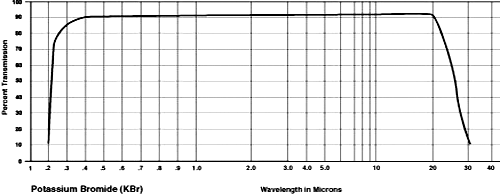
KBr transmittance. Sample thickness 10mm.
KBr properties |
|
|---|---|
| Chemical Formula | KBr |
| Molecular Weight | 119.01 |
| Crystal Class | Cubic |
| Lattice Constant, Е | 6.60 |
| Density, g/cm3 at 300 K | 2.75 |
| Absorption Coefficient, 1/cm at 2.7 µm at 3.8 µm |
1.2 x 10⁻⁴ 1.6 x 10⁻⁴ |
| Reflection Loss for two surfaces at 10 µm, % | 8.4 |
| Dielectric Constant for 102-1010 Hz at 298 K for 102-1010 Hz at 360 K |
4.9 4.97 |
| Melting Temperature, K | 1000 |
| Thermal Conductivity, W/(m K) at 319 K | 4.8 |
| Thermal Expansion, 1/K at 300 K | 38.5 x 10⁻⁶ |
| Specific Heat, cal/(g K) at 273 K | 0.104 |
| Debye Temperature, K | 174 |
| Bandgap, eV | 7.6 |
| KBr Solubility, g/100 g H2O at 273 K | 53.48 |
| Knoop Hardness, kg/mm2 | 7.0 [100] |
| Young's Modulus, GPa | 26.87 |
| Rupture Modulus, GPa | 0.0039 |
| Shear Modulus, GPa | 5.08 |
| Bulk Modulus, GPa | 15.02 |
KBr - Refractive Index
| µm | No | µm | No | µm | No |
|---|---|---|---|---|---|
| 0.405 | 1.5898 | 0.436 | 1.5815 | 0.486 | 1.5718 |
| 0.508 | 1.5684 | 0.546 | 1.5639 | 0.587 | 1.5600 |
| 0.643 | 1.5559 | 0.707 | 1.5524 | 1.014 | 1.5441 |
| 2.440 | 1.5373 | 3.419 | 1.5361 | 4.258 | 1.5352 |
| 6.238 | 1.5329 | 8.662 | 1.5290 | 9.724 | 1.5270 |
| 11.04 | 1.5240 | 14.29 | 1.5150 | 17.40 | 1.5039 |
| 19.91 | 1.4929 | 23.86 | 1.4714 | 25.14 | 1.4632 |
| 28.00 | 1.4423 | 30.00 | 1.4253 |