


Sapphire Windows, Lenses and Blanks: Custom Optical-Grade Al₂O₃ for Demanding Environments
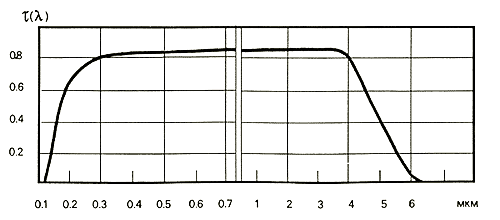
Alkor Technologies manufactures custom sapphire (Al₂O₃) optical windows, lenses, prisms and blanks — for vacuum chambers, high-pressure cells, semiconductor process equipment, laser systems, LiDAR sensors, IPL aesthetic devices and scientific instruments — on our own production site in Saint Petersburg, Russia. Transmission range 170 nm – 5.5 µm. Available in C-cut, A-cut, M-cut, R-cut and random orientation. Maximum window diameter 200 mm. Rectangular sapphire windows also available. Pressure window design tool included. AR coatings for MWIR 2–4 µm, 3–5 µm and other ranges. Custom quote within 24 hours.
Sapphire windows catalog (including Rectangular sapphire windows)
Sapphire optical lenses
Sapphire blanks: random or C/A/M/R orientation
Please contact us us for quotation of your Sapphire windows or lenses. Our Sales Team will prepare an answer within 24 hours.
Sapphire window feature:
- Extreme Surface Hardness Chemical Resistance
- Transmits Wavelengths Ranging From UV to Mid-Infrared
- Thinner and Stronger than Standard Glass Windows
- Sapphire window: Design of pressure windows in Excel file

Products: Full Sapphire Component Range
Sapphire Windows (Round and Rectangular)
Standard and custom round sapphire windows from 5 mm to 200 mm diameter. Rectangular sapphire windows and square windows to drawing. C-cut, random-cut and other orientations. Standard polishing: S/D 60-40. Precision: S/D 20-10, flatness λ at 633 nm. AR coatings 400-700 and 3000-5000nm available.
Sapphire Lenses
Plano-convex, bi-convex, plano-concave, meniscus. Diameter 5–80 mm. Used in endoscopes, high-temperature imaging systems, UV systems and IPL handpieces. C-cut standard for minimum birefringence.
Sapphire Blanks and Wafers
Polished and unpolished blanks in C-cut, A-cut, M-cut, R-cut and random orientation. For customers who perform in-house cutting, coating or epitaxial growth. Wafer diameters to specification. Material certificate with orientation and grade documentation.
Why Sapphire: Five Properties No Other Optical Material Combines
Sapphire occupies a unique position in optical engineering: it is the only widely available material that combines hardness, chemical inertness, broad UV-to-MWIR transmission, and high-temperature stability in a single substrate.
1. Hardness — second only to diamond. Sapphire features a Knoop hardness of 2200, whereas fused silica is only 460. This 4.8× hardness advantage means sapphire windows survive abrasive environments, sand impact, rain erosion and repeated contact cleaning that would permanently damage fused silica or borosilicate glass. Sapphire windows feature a Knoop Hardness of 1900 and are resistant to scratches, digs, and fractures that might otherwise weaken fused silica substrates.
2. Mechanical strength — thinner windows under pressure. Sapphire also boasts a tensile strength of 400 Megapascals compared to fused silica's 60 Megapascals. At the same pressure rating, a sapphire window can be approximately 2.5× thinner than an equivalent fused silica window. Thinner windows mean lower absorption, less path length, smaller package size and better thermal management.
3. Chemical inertness — survives aggressive process environments. Sapphire is chemically inert, insoluble in water, and resistant to common acids and alkalis. It survives concentrated nitric acid, hydrofluoric acid (below 300°C), plasma cleaning, ozone and most solvents that would attack optical glass, fused silica or fluoride crystals.
4. High temperature stability — operational to 1600°C+. Sapphire can operate up to 2030°C. While most organic coatings and adhesives fail above 300°C, a bare sapphire window survives furnace environments, high-temperature plasma and torch applications without degradation.
5. Broad spectral coverage — UV to MWIR in one material. Sapphire windows are transparent across a broad spectrum, from 170 nm to 5.5 µm, making them suitable for a wide array of optical applications. This range covers UV laser wavelengths (ArF 193 nm, KrF 248 nm), the visible range, NIR (used in LiDAR at 905/1064/1550 nm), and MWIR pyrometers and gas detectors in the 3–5 µm range.
Sapphire vs Fused Silica: Choosing the Right Window Material
Choose sapphire when:
— The window will be exposed to abrasion, sand, rain or direct contact (outdoor LiDAR, IPL handpieces)
— High pressure or vacuum requires a thin window with maximum strength
— Operating temperature exceeds 500°C
— Chemical resistance to aggressive acid or plasma environments is required
— MWIR coverage (3–5 µm) is needed alongside UV/visible transmission
Choose fused silica instead when:
— The application is purely in the UV-NIR range with no harsh environment
— Thermal shock resistance is more important than hardness (fused silica CTE = 5.5×10⁻⁷/K)
— Budget is constrained and the environment is controlled
— Birefringence is unacceptable (interferometric or polarimetric systems)
Crystal Orientation: C-Cut, A-Cut, M-Cut, R-Cut and Random
Sapphire is a uniaxial birefringent crystal (trigonal system, class R3c). The optical and physical properties of a sapphire window depend on the orientation of the crystal's c-axis (optic axis) relative to the polished face:
C-cut (0° cut, c-plane): The c-axis is perpendicular to the polished face. Light propagating through the window along the optical path travels parallel to the c-axis and experiences no birefringence — the ordinary and extraordinary rays coincide. C-cut sapphire is the standard choice for optical windows where polarisation preservation or minimal wavefront distortion is required.
A-cut (90° cut, a-plane): The c-axis lies in the plane of the window. Light travels perpendicular to the c-axis, experiencing maximum birefringence (Δn ≈ 0.008 at 1 µm). A-cut is used in wave plates and polarisation-sensitive optical elements.
M-cut (m-plane) and R-cut (r-plane): Intermediate orientations between C and A. Used in specialised electronic and photonic applications, epitaxial growth substrates.
Random orientation: The c-axis has no specified relationship to the window face. Random-cut blanks are the most economical option and are suitable where polarisation effects are not critical.
We supply all four orientations — C, A, M, R and random — as finished windows, lenses and polished blanks. Orientation verified by X-ray diffraction for precision applications.
Pressure Window Design: How Thick Should Your Sapphire Window Be?
Custom sapphire windows may include specific crystal orientations and surface coatings tailored to transmission, durability, and environmental resistance. For pressure applications, the critical design parameter is minimum window thickness — too thin and the window fractures; too thick and transmission, package size and cost suffer.
For a circular sapphire window under uniform pressure, the required minimum thickness depends on:
— Working pressure (MPa or psi)
— Clear aperture diameter (the unsupported span, not the outer diameter)
— Safety factor (typically 4× for general applications, 6–10× for life-critical)
— Mounting style (clamped edge vs simply supported)
— Crystal orientation (C-cut sapphire has different elastic properties than A-cut)
→ Download Pressure Window Design Calculator (Excel)
This calculator covers circular and rectangular windows in sapphire, fused silica, CaF₂ and other materials. Enter your aperture size, working pressure and safety factor — the tool returns the required minimum thickness for sapphire, fused silica and BK7 simultaneously for comparison.
Applications: Where Sapphire Windows Are Deployed
Vacuum Viewports and High-Pressure Chambers
In ultra-high vacuum (UHV) applications, sapphire sight glass is commonly brazed or sealed into glass-to-metal assemblies for cryogenic viewing ports, high-temperature furnaces, and semiconductor processing. Sapphire's combination of chemical inertness, high tensile strength and compatibility with metal-ceramic sealing makes it the preferred viewport material where:
— Operating pressure exceeds the capability of borosilicate glass (>10 bar differential)
— Temperature exceeds the capability of optical glass or fluoride crystals (>500°C)
— The process environment is chemically aggressive (acids, plasma, ozone)
— Outgassing must be minimised (sapphire is a stoichiometric oxide with negligible outgassing)
We supply sapphire viewport windows in standard sizes for CF (ConFlat), ISO-KF and custom flange formats. Rectangular and round formats. Thicknesses calculated to your pressure specification.
Semiconductor Processing Equipment
Sapphire windows demonstrate exceptional resistance to corrosive chemicals, high-pressure fluids, and vacuum environments. This reliability makes them well-suited for semiconductor processing and aggressive chemical applications. Sapphire is standard in:
— CVD and PECVD reactor viewports (plasma and reactive gas environments)
— Etch chamber observation windows (fluorine-based plasmas, aggressive etch chemistries)
— Rapid thermal processing (RTP) furnace windows — operating temperatures to 1200°C
— Ion implant beamline viewports
— CMP endpoint detection windows
All these applications share a requirement that sapphire uniquely satisfies: optical transmission for monitoring/measurement, combined with resistance to conditions that would rapidly destroy any alternative window material.
Outdoor LiDAR and Sensors
For commercial outdoor LiDAR sensors (905 nm, 1064 nm, 1550 nm), sapphire provides scratch resistance that eliminates the surface degradation problem that limits the life of fused silica and glass protective windows in road-dust environments. Autonomous vehicle LiDAR units with sapphire front windows survive the equivalent of tens of thousands of road kilometers without requiring window replacement.
Laser Systems: High-Power, UV and Femtosecond
For laser applications, sapphire's ability to resist laser damage makes it a critical material for protective laser windows, beam splitters, output couplers.
Sapphire is used in laser systems where fused silica would be the default choice but environmental durability matters more than cost:
— High-power diode laser protection windows (scratch resistance for cleaning cycles)
— Output windows for laser systems operating in dusty or corrosive environments
— UV laser windows at 266 nm, 308 nm, 355 nm (sapphire transmits well through the UV)
— Laser-based machining systems where spatter abrades the protective window
IPL Aesthetic and Medical Devices
Famous aesthetic manufacturers, Candela, Syneron, Lumenis, DEKA, and Alma Lasers choose sapphire windows as the main contacting material for their aesthetic machines.
The sapphire contact piece in IPL and laser-based hair removal, skin rejuvenation and vascular treatment systems serves three simultaneous functions:
— transmits intense pulsed light (400–1200 nm range) to the treatment zone
— provides direct contact cooling of the skin surface (sapphire thermal conductivity 27.21 W/(m·K) — 20× higher than fused silica)
— withstands repeated physical contact with skin without scratching
Scientific Instruments: Cryostats, Spectroscopy and Astronomy
Sapphire viewport windows for cryostats and liquid nitrogen/helium systems — sapphire maintains its mechanical properties and transmission at cryogenic temperatures where many optical glasses become brittle or opaque. For Raman spectroscopy cells, sapphire provides inertness to aggressive solvent environments with high pressure. For astronomical instruments, sapphire protection windows for spectrograph detectors operating at MWIR wavelengths.
Sapphire is used for windows in 250-5000nm wavelength range. It is recognized as a highly important optical material because optical grade sapphire combines high transmission with outstanding mechanical-strength properties at high temperatures. Sapphire windows can be made thinner than alternative crystals thanks to its structural integrity and can operate up to 2030⁰C.
Sapphire windows are widely used as protective windows or viewports. Sapphire windows are ideal for applications where high pressure, vacuum, or corrosive atmospheres are a consideration.
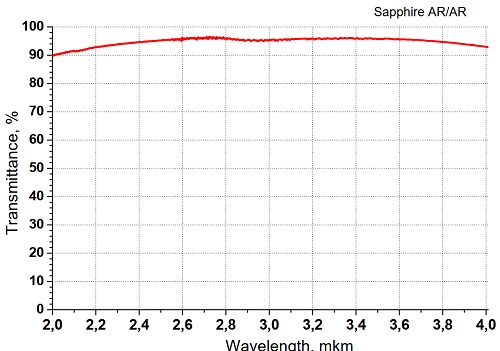
AR/AR coating for 2-4microns.
Sapphire optical properties, chemical, mechanical properties |
|
|---|---|
| Transmission Range | 0.17 to 5.5 μm |
| Refractive Index | No 1.75449; Ne 1.74663 at 1.06 μm (1) |
| Reflection Loss | 14% at 1.06 μm |
| Absorption Coefficient | 0.3 x 10⁻³ cm-1 at 2.4 μm (2) |
| Reststrahlen Peak | 13.5 μm |
| dn/dT | 13.1 x 10⁻⁶ at 0.546 μm (3) |
| dn/dμ = 0 | 1.5 μm |
| Density | 3.97 g/cc |
| Melting Point | 2040°C |
| Thermal Conductivity | 27.21 W m-1 K-1 at 300K |
| Thermal Expansion | 5.6 (para) & 5.0 (perp) x 10-6/K * |
| Hardness | Knoop 2000 with 2000g indenter |
| Specific Heat Capacity | 763 J Kg-1 K-1 at 293K (4) |
| Dielectric Constant | 11.5 (para) 9.4 (perp) at 1MHz |
| Youngs Modulus (E) | 335 GPa |
| Shear Modulus (G) | 148.1 GPa |
| Bulk Modulus (K) | 240 GPa |
| Elastic Coefficients | C11=496 C12=164 C13=115 C33=498 C44=148 |
| Apparent Elastic Limit | 300 MPa (45,000 psi) |
| Poisson Ratio | 0.25 |
| Solubility | 98 x 10-6 g/100g water |
| Molecular Weight | 101.96 |
| Class/Structure | Trigonal (hex), R3c |
| Wavelength, μm | No | Ne |
|---|---|---|
| 0.193 | 1.92879 | 1.91743 |
| 0.213 | 1.88903 | 1.87839 |
| 0.222 | 1.8754 | 1.86504 |
| 0.226 | 1.87017 | 1.85991 |
| 0.244 | 1.85059 | 1.84075 |
| 0.248 | 1.84696 | 1.83719 |
| 0.257 | 1.83932 | 1.82972 |
| 0.266 | 1.83304 | 1.82358 |
| 0.280 | 1.82437 | 1.81509 |
| 0.308 | 1.81096 | 1.80198 |
| 0.325 | 1.80467 | 1.79582 |
| 0.337 | 1.80082 | 1.79206 |
| 0.351 | 1.79693 | 1.78825 |
| 0.355 | 1.79598 | 1.78732 |
| 0.442 | 1.78038 | 1.77206 |
| 0.458 | 1.77843 | 1.77015 |
| 0.488 | 1.7753 | 1.76711 |
| 0.515 | 1.77304 | 1.76486 |
| 0.532 | 1.7717 | 1.76355 |
| 0.590 | 1.76804 | 1.75996 |
| 0.633 | 1.7659 | 1.75787 |
| 0.670 | 1.76433 | 1.75632 |
| 0.694 | 1.76341 | 1.75542 |
| 0.755 | 1.76141 | 1.75346 |
| 0.780 | 1.76068 | 1.75274 |
| 0.800 | 1.76013 | 1.7522 |
| 0.820 | 1.75961 | 1.75168 |
| 0.980 | 1.75607 | 1.81974 |
| 1.064 | 1.75449 | 1.74663 |
| 1.320 | 1.75009 | 1.74227 |
| 1.550 | 1.74618 | 1.73838 |
| 2.010 | 1.73748 | 1.72973 |
| 2.249 | 1.73232 | 1.72432 |
| 2.703 | 1.719 | 1.711 |
| 2.941 | 1.712 | 1.704 |
| 3.333 | 1.701 | 1.693 |
| 3.704 | 1.687 | 1.679 |
| 4.000 | 1.674 | 1.666 |
| 4.348 | 1.658 | 1.65 |
| 4.762 | 1.636 | 1.628 |
| 5.000 | 1.623 | 1.615 |
| 5.263 | 1.607 | 1.599 |