|
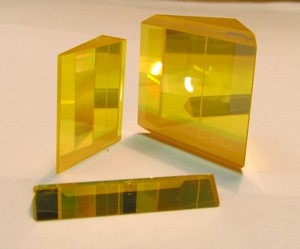
Alkor Technologies supplies prisms made of the following materials: BaF2, CaF2,Fused Silica, LiF, optical glasses, Sapphire, Si, ZnSe:
The following prisms are available upon request:
- Equilateral prism
- Equilateral prisms have three equal 60 degrees angle and are also referres to as dispersing prisms.
- Amici prism
- Dove prism - As the dove prism is rotated about its own long axis, the orientation of its image rotates at twice the angular displacement. Thus an image can be rotated through 180 degrees by rotating the dove prism through only 90 degrees. Engineers use dove prisms to invert an image or to provide continuous control of the orientation of an inverted image.
- Pellin-Broca prism
- Pentaprism- The penta prism deviates a beam through 90 degrees in a way that preserves the orientation of the input. Our standard penta prisms come with either second surface aluminum or second surface silver coating on the reflecting surfaces. Most people familiar with penta prisms have gained their knowledge from single lens reflex (SLR) cameras. A penta prism used in an SLR camera serves to fold the path of the viewfinder system. Another application for penta prisms can be found in laser scanning systems where a rotating penta prism is substituted for a rotating polygon mirror or holographic disc.
- Porro prism
- Porro-Abbe prism
- Right angle prism - Engineers or designers commonly make use of a right angle prism's total internal reflection. They use the right angle prism in one of two orientations. The first is called the single mirror or leg-hypotenuse-leg orientation. The second is called the double mirror or hypotenuse-leg-leg-hypotenuse orientation. For both orientations, incoming light must travel parallel to the plane that includes the right angle vertex.
- Wedge prism - Common names for a wedge include wedged window and thick or thin prisms. Used as a wedged window, a wedge can control the direction of back-reflected light at each surface. Applications for wedged windows, as opposed to standard plane-parallel windows, can be found in lasers and interferometers. As a thick or thin prism, a wedge can be used to disperse light into its constituent colors. Color analyzers and spectrographic instruments contain prisms or diffraction gratings to bend light of different colors into different angles for analysis
- Corner Cube Retroreflectors (Trihedral prisms)
- Corner cube prisms are designed to reflect any ray or beam entering the prism face, regardless of the orientation of the prism. Retroreflectors will function even at a very large angles of incidence. There are three total internal reflections within the corner cube.
| |
Size tolerance,mm |
Angle tolerance |
Flatness |
Surface quality |
| Standard |
+0, -0.2 |
3 arc. min |
1 lambda at 0.63mkm |
60/40 |
| Achievable |
+0, -0.02 |
1 arc.min |
Lambda/10 at 0.63 mkm |
10/5 |
See also: optical lenses, optical windows and wedges |