


Sodium Chloride (NaCl) Windows, Drilled Discs and Lenses: FTIR and CO₂ Laser Optics
Alkor Technologies manufactures sodium chloride (NaCl) optical windows, drilled discs (demountable cuvette windows with filling holes), lenses and wedges from single-crystal NaCl grown by the Kyropoulos method — on our own production site in Saint Petersburg, Russia. Transmission range 0.25–16 µm. Maximum blank size 100 mm diameter × 25 mm thickness. Compatible standard sizes for Thermo Fisher Scientific (Nicolet), PerkinElmer, Agilent, Shimadzu, Pike Technologies and other FTIR platforms. All NaCl optics shipped in sealed packaging with silica gel desiccant. Custom quote within 24 hours.
Check our catalog of NaCl windows or contact Sales Team for more information.
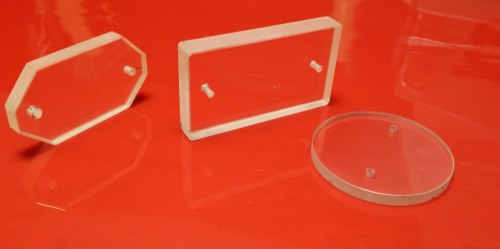

NaCl in Optics: The Lowest-Cost Path to Full Mid-IR Coverage
Sodium chloride is the most economical optical material that covers the complete mid-IR range from 250 nm to 16 µm. NaCl is a relatively low-cost cubic crystalline material that has excellent transmission from 250 nm to 16 µm.
Two properties give NaCl its practical advantage over competing IR materials:
Lowest reflection loss among the alkali halides. The refractive index of NaCl at 10 µm is approximately 1.49 — lower than KBr (n ≈ 1.53) and much lower than ZnSe (n ≈ 2.40). Fresnel reflection loss from two uncoated surfaces at 10 µm is just 7.5% for NaCl, compared to 8.3% for KBr and 29% for ZnSe. This means NaCl windows deliver the highest uncoated transmission among IR alkali halides.
Lowest absorption in the FTIR mid-IR range. Because of its low absorption, sodium chloride is used in high-powered laser systems. In CO₂ laser systems operating at 10.6 µm, low absorption prevents localised heating, thermal lensing and optic damage at power densities where higher-absorption materials would fail.
Key limitation: NaCl is hygroscopic. It dissolves in water (35.7 g/100 g H₂O at 0°C) and its polished surfaces are attacked by atmospheric moisture — gradually losing optical quality through surface dissolution. All Alkor NaCl optics are shipped in sealed packaging with silica gel to protect them from the point of manufacture to your lab bench.
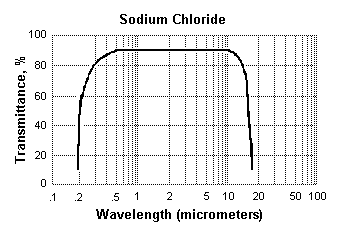
NaCl transmittance. Sample thickness 10mm.
NaCl vs KBr vs ZnSe: Which Material for Your Cuvette?
Choose NaCl when:
— The MIR range 650–4000 cm⁻¹ is sufficient for your analytes (organic compounds, hydrocarbons, polymers, most pharmaceuticals)
— Budget is a priority — NaCl is the most economical option
— High-power CO₂ laser windows where low absorption at 10.6 µm is critical
— Your samples are non-aqueous (organic solvents: CCl₄, CS₂, hexane, chloroform, toluene)
Choose KBr instead when:
— You need the full FTIR range to 400 cm⁻¹ (25 µm), including the far-IR fingerprint bands of inorganic compounds, coordination complexes, and metal halides
— You are running a KBr pellet or mull method where the cuvette window matches the background material
Choose ZnSe instead when:
— Your samples contain water or aqueous solvents
— You need mechanical durability for repeated cleaning cycles
Two Key Applications for NaCl Optics
FTIR Spectroscopy Cuvette Windows
NaCl windows are the original and most widely used material for demountable liquid IR cells. The windows are clamped together with a thin spacer (typically PTFE, 0.01–1 mm) to form a cell that holds a liquid sample while the IR beam passes through.
NaCl optics, including cell windows, are used in FTIR spectrometers due to their wide transmission range into the infrared region. They can be used to hold non-polar liquid samples, which will not degrade the material.
Standard FTIR cuvette window applications include:
— identification and purity analysis of organic compounds in non-polar solvents (CCl₄, CS₂, hexane, chloroform)
— quality control of petroleum products, fuels, oils and lubricants in the 650–4000 cm⁻¹ range
— analysis of polymer films, coatings and resins by transmission
— pharmaceutical analysis of active ingredients in non-aqueous media
— quantitative analysis via Beer-Lambert calibration at characteristic absorption wavelengths
Drilled NaCl windows (windows with a small central filling hole, typically 1–3 mm diameter) are used in sealed demountable cells where the sample is injected with a syringe through the hole after the cell is assembled. The drilling eliminates the need to disassemble the cell between samples. We manufacture drilled NaCl discs to your specification — any hole diameter, any position.
CO₂ Laser Windows and Optics (10.6 µm)
Sodium chloride windows can be used in high-powered laser systems, such as CO₂ lasers, due to their low absorption. They are often used to protect other laser optics such as zinc selenide or YAG focusing lenses.
NaCl is one of the earliest and most extensively characterised optical materials for CO₂ lasers. Its absorption coefficient at 10.6 µm is among the lowest of any practical window material, making it suitable for high-power continuous-wave CO₂ systems where even small absorption leads to thermal lensing and optic damage.
In early high-power CO₂ laser systems, NaCl windows were the standard output coupler and beam delivery element before the availability of high-quality ZnSe. Today NaCl remains preferred in:
— scientific and laboratory CO₂ laser systems where moisture can be controlled
— gas cells for laser absorption spectroscopy at 10.6 µm
— output windows for pulsed CO₂ systems in controlled environments
— resonator elements in spectroscopic CO₂ laser setups
Limitation: in production environments with uncontrolled humidity, ZnSe is the preferred alternative because NaCl's moisture sensitivity limits its practical lifetime. For controlled laboratory environments, NaCl offers superior transmission at lower cost.
Standard Sizes: Catalog of NaCl Windows
We manufacture NaCl windows in standard sizes compatible with all major FTIR cuvette holders. Custom dimensions to drawing. All sizes available plain (undrilled) and drilled (with filling hole).
Round NaCl windows | |
|---|---|
| NaCl 13x2 | not drilled |
| 15 x 2 мм | not drilled |
| 19 x 2 мм | not drilled |
| 20 x 2 мм | not drilled |
| 22 x 2 мм | not drilled |
| 22 x 4 mm | not drilled |
| 25 x 2 мм | not drilled |
| 25 x 4 мм | not drilled |
| NaCl 32x3 мм | drilled/ not drilled |
| 38 x 3 мм | not drilled |
| 38 x 6 мм | not drilled |
| 40 x 4 мм | not drilled |
| 49 x 6 мм | not drilled |
| 50 x 3 мм | not drilled |
| Also available in the same sizes in KBr, KCl, ZnSe, BaF₂, CaF₂, Ge | |
Rectangle NaCl windows
Rectangle NaCl windows | |
|---|---|
| 29.5 x 14.5 x 2 mm | drilled/ not drilled |
| 29.5 x 14.5 x 4 mm | drilled/ not drilled |
| 35.8 x 19.8 x 4 mm | drilled/ not drilled |
| 38.5 x 19.5 x 4 mm | drilled/ not drilled |
| 41 x 23 x 3 mm | drilled/ not drilled |
| 41 x 23 x 4 mm | drilled/ not drilled |
| 45 x 20 x 6 mm | drilled/ not drilled |
| 50 x 25 x 6 mm | drilled/ not drilled |
| Also available in the same sizes in KBr, KCl, ZnSe, BaF₂, CaF₂, Ge | |
Compatible with: Thermo Fisher Scientific (Nicolet), PerkinElmer (Spectrum), Agilent (Cary 600), Shimadzu (IRAffinity, IRTracer), Pike Technologies, Bruker, JASCO and most other FTIR platforms. Also available in the same sizes in KBr, KCl, ZnSe, BaF₂, CaF₂, Ge — all from one supplier.
Request a Quote for NaCl Windows
Send your specifications to technologies@alkor.net: size (diameter × thickness or length × width × thickness), drilled or plain, quantity, and the FTIR instrument model if ordering replacement cuvette windows. We will match the correct size and confirm availability within 24 hours.
NaCl main properties |
|
|---|---|
| Chemical Formula | NaCl |
| Crystal Class | Cubic |
| Lattice Constant, Е | 5.65 |
| Molecular Weight | 58.45 |
| Density, g/cm3 at 293 K | 2.17 |
| Reflection Loss, % for two surfaces at 10 µm | 7.5 |
| Dielectric Constant for 102-2.5x10¹⁰ Hz at 298 K at 358 K |
5.9 6.35-5.97 |
| Melting Temperature, K | 1070 |
| Thermal Conductivity, W/(m K) at 80 K at 289 K at 400 K |
35.1 6.5 4.85 |
| Thermal Expansion, 1/K at 75 K at 273 K at 1000 K |
19.0 40.0 69.5 |
| Specific Heat, cal/(g K) at 273 K | 0.20 |
| Debye Temperature, K | 321 |
| Bandgap, eV | 9.0 |
| Solubility, g/100 g H2O at 273 K | 35.7 |
| Knoop Hardness | 15.2 [110] 18.2 [100] |
| Young's Modulus, GPa | 39.96 |
| Rupture Modulus, GPa | 0.00393 |
| Shear Modulus, GPa | 8.97 |
| Bulk Modulus, GPa | 24.32 |
NaCl index of refraction
| µm | No | µm | No | µm | No |
|---|---|---|---|---|---|
| 0.589 | 1.54427 | 0.640 | 1.54141 | 0.760 | 1.53682 |
| 0.884 | 1.53395 | 0.972 | 1.53253 | 1.054 | 1.53153 |
| 1.555 | 1.53815 | 2.074 | 1.52736 | 9.000 | 1.501 |
| 9.500 | 1.4998 | 10.60 | 1.49065 | 11.40 | 1.48476 |
| 12.50 | 1.47568 | 13.50 | 1.4666 | 14.60 | 1.45572 |
| 16.00 | 1.4399 | 17.80 | 1.41649 | 19.80 | 1.38559 |
| 20.57 | 1.3735 | 22.30 | 1.3403 |