


Home>>Products>>Optical mirrors
Optical Mirrors: Metal-Coated, Dielectric and IR Mirrors — from UV to 25 µm
Alkor Technologies manufactures custom optical mirrors — flat and concave — with metallic and dielectric coatings for applications from the deep UV (120 nm) to the far IR (25 µm). We produce protected aluminum, protected silver, protected gold, Al+MgF₂ UV mirrors, Si+Au CO₂ laser mirrors and high-reflectance dielectric mirrors. Substrates: optical glass K8/N-BK7, fused silica, silicon, Zerodur, sapphire and other optical materials. Diameter from 5 mm to 200 mm. Flatness to λ/10. Custom quote within 24 hours.
These products are offered in a variety of metallic and dielectric coatings that suit all your application requirements.
Please contact us for pricing and delivery terms of your custom optical mirror!
Protected Aluminum optical mirrors
Standard protected aluminum is the most popular metallic mirror coating for applications in the visible and near infrared. A thin layer of aluminum is deposited on the substrate, then overcoated with a protective dielectric layer (typically SiO₂ or MgF₂) that prevents oxidation of the aluminum surface while preserving reflectance and allowing the mirror to be handled and cleaned without damage.
Protected Aluminum (Al+SiO₂):
— Ravg > 90% from 450 nm to 2 µm
— Ravg > 95% from 2 µm to 20 µm
— Suitable for broadband VIS, NIR, MWIR and LWIR applications
UV-Enhanced Aluminum (Al+MgF₂):
— Extends useful reflectance into the deep UV: usable from 120 nm
— Ravg > 85% at 200 nm, better UV performance than Al+SiO₂
— For 200–250 nm wavelength applications it is recommended to use MgF₂ as the protective layer — it gives higher reflection values in the UV spectrum than SiO₂.
— Standard coating for UV spectrometer mirrors, telescope primaries for UV astronomy, synchrotron beamline components
Aluminum is the most versatile metallic mirror coating — it is the correct choice when broadband coverage from UV to IR is needed and absolute maximum reflectance at any single wavelength is not required.

Protected Silver Mirrors
Silver provides the highest reflectance of any metallic mirror coating across the visible and near-IR spectrum. Thorlabs offers silver-coated mirrors specifically designed for ultrafast applications in the fundamental wavelength range of femtosecond Ti:Sapphire lasers.
Protected Silver (Ag):
— Ravg > 97% from 450 nm to 20 µm
— Highest metallic reflectance in the VIS/NIR (typically 2–4% higher than aluminum)
— Suitable for femtosecond and ultrafast laser systems (minimal group delay dispersion compared to dielectric coatings)
— Broadband imaging systems where maximum throughput is critical
The limitation of silver: it oxidises and tarnishes more readily than gold. A protective dielectric overcoat is essential. Even with protection, silver mirrors have somewhat lower durability than gold mirrors in high-humidity or contaminating environments.
Silver is the best choice when: the application is in the visible or NIR range, maximum reflectance over a broad spectral band is more important than deep UV or far-IR coverage, and the operating environment is controlled.
Protected Gold optical mirrors
Gold mirrors are effective for applications requiring high reflectance in the NIR and IR. Reflection in the visible spectrum is poor. Gold begins to reflect efficiently above ~700–800 nm, with reflectance rising rapidly to >97% and remaining stable across the full IR range to beyond 25 µm.
Protected Gold (Au):
— Ravg > 96% from 800 nm to 25 µm
— Poor reflectance below 600 nm — gold appears yellow/orange in reflection because it absorbs blue and green wavelengths
— Chemically inert — gold does not oxidise or tarnish, making it the most stable metallic mirror coating over time
— Standard coating for FTIR spectrometer beam-steering mirrors, pyrometry systems, CO₂ laser systems and all far-IR applications
Substrates for gold mirrors: We deposit Au on fused silica, optical glass K8/N-BK7, silicon and other crystalline substrates. Gold mirrors can be produced on fused silica, silicon and other optical crystal substrates. For LWIR applications where coating material matters more than substrate, we recommend silicon or fused silica for their low expansion and high surface quality retention after polishing.
Gold mirror: Ravg >96% 800 nm to 20 μm. Read more.
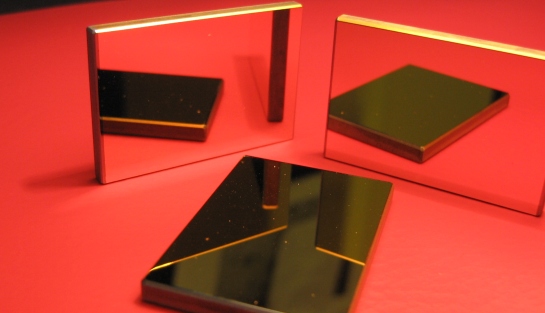
Silicon+Gold Mirrors for CO₂ Laser Systems
The Si+Au mirror is the standard beam-delivery mirror in CO₂ laser cutting, engraving and marking systems. The combination of substrate and coating is chosen for three specific reasons:
Silicon substrate — high thermal conductivity. Due to its high thermal capacity, silicon serves as an ideal substrate for reflectors, particularly in applications like CO₂ laser cutters. Silicon's thermal conductivity of 163 W/(m·K) is nearly three times higher than germanium (58.6 W/(m·K)) and significantly higher than fused silica (1.38 W/(m·K)). When a small fraction of CO₂ laser power is absorbed by the mirror (even a <3% loss at 10.6 µm), it must be conducted away rapidly to prevent thermal distortion of the mirror surface. Silicon conducts this heat so efficiently that thermal lensing effects are minimised even at kilowatt power levels.
Lighter than copper. Water-cooled copper mirrors are used in the highest-power CO₂ systems, but at moderate powers (up to several kilowatts), Si+Au provides adequate thermal management at roughly half the weight of a copper mirror of equivalent diameter. This reduces vibration in high-speed scanning heads.
Gold coating — >97% reflectance at 10.6 µm. Gold is the standard reflective coating for CO₂ laser wavelengths, providing >97% reflectance with minimal absorption and no coating degradation at moderate continuous-wave powers.
We manufacture Si+Au mirrors in standard and custom diameters, flat and concave geometries, for CO₂ laser systems from 100 W to multi-kilowatt output.
Dielectric High-Reflectance Mirrors
Optical mirrors with a broadband dielectric coating have a narrower spectral range of operation; the average reflectivity throughout the specified region is greater than 99%. Dielectric mirrors use multiple thin-film layers of alternating high- and low-refractive-index materials to create reflectance by constructive interference — achieving reflectance levels impossible with metallic coatings.
Key advantages of dielectric over metallic:
— Reflectance >99.5% at design wavelength — sometimes >99.9% for precision laser resonators
— Very low absorption — critical in high-power laser resonators where even 0.5% absorption causes significant heating
— Customisable to any wavelength or wavelength range from UV to LWIR
Standard dielectric mirror specifications from Alkor Technologies:
— R >99.5% at specified laser wavelength
— Standard wavelengths: 355 nm, 532 nm, 1064 nm, 1310 nm, 1550 nm, 10.6 µm
— Angle of incidence: 0° (normal incidence) or 45°, other angles on request
— Laser Mirrors feature tight surface qualities, providing minimal scatter for beam steering applications.
Dielectric Laser Mirror coatings optimized for common laser wavelengths provide higher reflection than achievable with metallic coatings.
Limitation: dielectric mirrors are wavelength-specific. A mirror designed for maximum reflectance at 1064 nm will not perform well at other wavelengths. For broadband applications, metallic coatings are more appropriate.

Whether you require custom optical fabrication or one of our many off-the-shelf IR optical mirrors, let us provide you with a prompt competitive quotation today!